College creates Robotics Hub in new Emergent Information Technology Lab
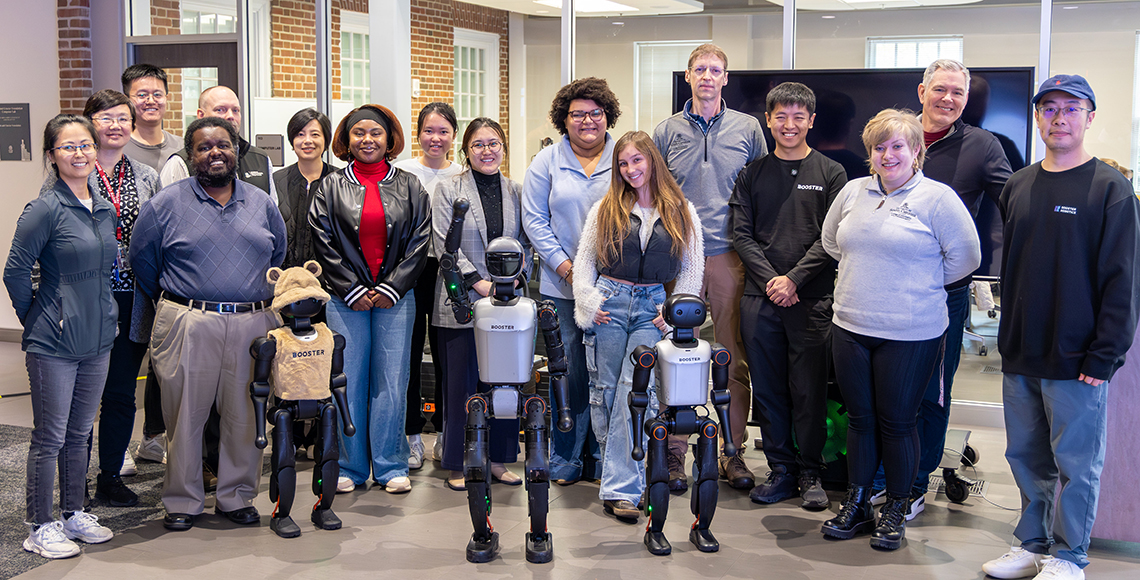
CIC students and faculty enjoyed a demonstration by Booster Robotics. Watch a short
video.
College creates Robotics Hub in new Emergent Information Technology Lab
Posted on: December 10, 2025; Updated on: February 2, 2026 By Lois Isaiah, Honors College freshman
An associate professor in the School of Journalism and Mass Communications is leading
a charge to expand the future of artificial intelligence and robotics at USC.
Fan Yang
Fan Yang, Ph.D., is the director of the Emergent Information Technology Lab in the College of Information and Communications and the lead of the Robotics Hub.
Housed within the college, the Emergent Information Technology Lab is a collaborative space that will merge robotics, artificial intelligence and augmented
and virtual reality to explore the rapidly evolving relationship between humans and
intelligent machines. The goal is to explore how humans interact with technology that
is quickly becoming part of everyday life.
“I’m really fascinated by how AI-powered robotics interact with us and play a role
in our daily lives,” Yang said. “Whether you like it or not, robots are entering our
world, and in some cases replacing our workforce. We have to understand how to better
interact with them.”
Yang’s fascination with robotics grew from the rapid rise of artificial intelligence
in 2023, when ChatGPT and other generative AI tools captured global attention and
reshaped the technology landscape.
Fan Yang studies how we will communicate with robots as the technology becomes more
widespread
“It completely blew everybody’s mind,” Yang said. “It rejuvenated the entire robotics
industry because it gave robots that soul, the ability to understand and interact.”
That spark of curiosity led to a deeper exploration of how AI-powered robots communicate
and work alongside humans. After years of research and leadership at the University
of South Florida, Yang joined USC in 2025 to help build the new Emergent Technology
Lab, a space designed to connect students, faculty and technology in meaningful ways.
“Our leadership here is very forward-thinking,” Yang said. “They realize we need to
stay on top of cutting-edge technology — and robotics is undoubtedly part of that.”
The lab will feature three interconnected hubs: Robotics, AR/VR and AI. Together,
these teams will collaborate on studies of human-robot and human-AI interaction to
combine technical development with research on communication and ethics.
Yang has seen a range of emotional responses to robotics. During her tours at the
University of South Florida — which included college students and elementary school students — Yang brought out a small countertop robot, and reactions ranged from fascination
to fear.
“College students were scared,” Yang said. “But fifth graders were excited. As we
get older, our preconceptions make us more resistant to new things.”
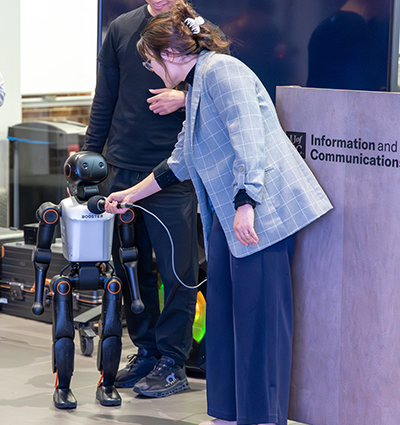
This student is controlling a robot during a recent demonstration in the SJMC by Booster
Robotics.
She said that difference in the reaction of students revealed something important
about learning and curiosity. Yang believes early exposure helps students break through
fear and develop realistic expectations about how robotics actually work.
“Once people avoid new technology, they fall behind,” Yang said. “Through our labs,
we can help students engage with robotics and AI in a way that’s comfortable, open
and curious.”
CIC Associate Dean for Research Linwan Wu, Ph.D., said preparing students for a technology-driven future is central to the college’s
mission.
“When it comes to AI, we really focus on human–AI interaction,” Wu said. “We want
to prepare students for careers where they will work with AI.”
As AI becomes more powerful, ethical questions are evolving just as quickly. Yang
said that determining the right way to use AI is not always clear and will be an important
task for the lab.
“We’re still figuring out what’s ethical in AI,” they said. “The rules keep changing
as technology grows. What matters most is keeping an open, ongoing discussion.”
That spirit of conversation will guide the new lab as it prepares to open. The Robotics
Hub aims to help students develop realistic expectations about what robots can and
can’t do.
“Some people think robots are clunky and outdated, while others think they’re just
like humans,” Yang said. “The truth is in between. It takes the whole world to make
even one small breakthrough.”
The Emergent Technology Lab is expected to open in the spring of 2026. USC students
will have the opportunity to work with robotics, AI and immersive technology firsthand.
Yang hopes the new space will help students understand that technology isn’t something
to fear, but it’s something to learn from.
“Whether we love or hate robotics, we can’t avoid it,” Yang said. “That’s why it’s
so important for students to be exposed to these technologies early. The more we understand
them, the better we can shape the future.”
About the Author
Lois Isaiah
Lois Isaiah is a freshman in the USC Honors College, where she is pursuing a degree
in civil engineering. She wrote this story for her Honors Writing for Mass Communication
course taught by Bertram Rantin. Beyond academics, Isaiah enjoys community service
and leadership as a member of the Black Honors Caucus, serving on its special events
committee.
Challenge the conventional. Create the exceptional. No Limits.