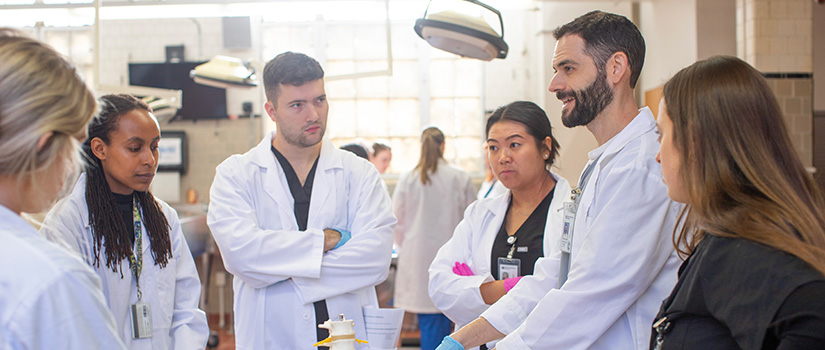
Throughout the program, students gain practical experience through simulation-based
learning, supervised clinical education, and cadaver-based anatomy instruction. Didactic
instruction is delivered primarily in person, face-to-face, allowing for active learning
and close faculty engagement. Limited asynchronous or online components may be incorporated
to support specific course objectives. Small class sizes ensure individualized attention
and meaningful interaction with faculty.
Degree
Students in the Physician Assistant Program at the Floy School of Medicine earn a
Master of Science in Physician Assistant Studies upon successful completion of the
27-month curriculum, which includes both didactic and clinical education.
Didactic Curriculum
The first phase of the program is the didactic year, during which students participate
in primarily in-person classroom instruction designed to build the medical knowledge
and clinical skills necessary for success in clinical training. While the majority
of coursework is delivered face-to-face, select courses or learning activities may
include asynchronous or online components.
One course, BMSC 744: Interprofessional Seminar, is delivered largely in an asynchronous,
online format and includes three required live sessions. The format of these live
sessions may vary and may be conducted either in person or virtually.
Course Number
Course Name
Credit Hours
PHPH 701
Physiology for Health Sciences
6
BMSC 740
Human Anatomy for Health Sciences
6
BMSC 745
Medical Interviewing
2
BMSC 753
PA Professional Practice
1
Course Number
Course Name
Credit Hours
BMSC 766
PA Clinical Medicine and Therapeutics I
7
BMSC 746
Physical Diagnosis
6
BMSC 755
Medical Genetics and Laboratory Diagnostics
2
BMSC 752
Medical Law and Ethics
2
Course Number
Course Name
Credit Hours
BMSC 767
PA Clinical Medicine and Therapeutics II
6
BMSC 768
PA Clinical Medicine and Therapeutics III
6
BMSC 751
Behavioral Health
2
BMSC 756
Advancing Medical Practice through Research
3
BMSC 747
Diagnostic Testing
2
Course Number
Course Name
Credit Hours
BMSC 769
PA Clinical Medicine and Therapeutics IV
7
BMSC 770
Clinical Skills Lab
3
BMSC 748
Surgery and Emergency Medicine
2
BMSC 743
Clinical Immersion for PAs
2
BMSC 744
Interprofessional Seminar
1
BMSC 749
Clinical Medicine Across the Lifespan
2
Clinical Curriculum
The clinical phase of the program is dedicated to the development and application
of advanced clinical skills required for entry-level physician assistant practice.
During this phase, students complete a series of supervised clinical practicum experiences
across a variety of medical and surgical specialties, providing broad exposure to
patient care in diverse practice settings.
Students are not required to identify or secure clinical sites or preceptors; all
clinical placements are arranged by the program.
Throughout the clinical year, students complete BMSC 783: PA Capstone Portfolio, a
longitudinal project that is developed over the duration of the clinical phase and
must be completed prior to graduation.
Course Number
Course Name
Credit Hours
BMSC 781
Family Medicine (Practicum)
4
BMSC 782
Urgent Care/Primary Care 2
4
BMSC 759
Women’s Health (Practicum)
4
BMSC 758
Internal Medicine (Practicum)
4
BMSC 760
Pediatrics (Practicum)
4
BMSC 761
Behavioral Medicine (Practicum)
4
BMSC 762
General Surgery (Practicum)
4
BMSC 763
Emergency Medicine (Practicum)
4
BMSC 764
Orthopedics (Practicum)
4
BMSC 765
PA Practicum Elective–two rotations totaling 8 weeks
4
Course Number
Course Name
Credit Hours
BMSC 783
PA Capstone Portfolio
1
BMSC 742
Seminar (Summative Experience)
1
Summary
Year
Credit Hours
Didactic Curriculum
68
Clinical Curriculum
46
Total
114
Summative Experience
Prior to graduation, students return to campus to complete BMSC 742: Seminar (Summative
Experience), a required face-to-face course designed to support the transition from
student to professional practice. Seminar activities include, but are not limited
to, completion of remaining graduation requirements, required comprehensive assessments,
final submission of the PA Capstone Portfolio, and participation in a Physician Assistant
National Certifying Exam (PANCE) review focused on exam preparation and professional
readiness. Additional seminar activities may include professional development sessions,
exposure to professional organizations and leadership opportunities, and preparation
for employment and postgraduate training.
Challenge the conventional. Create the exceptional. No Limits.