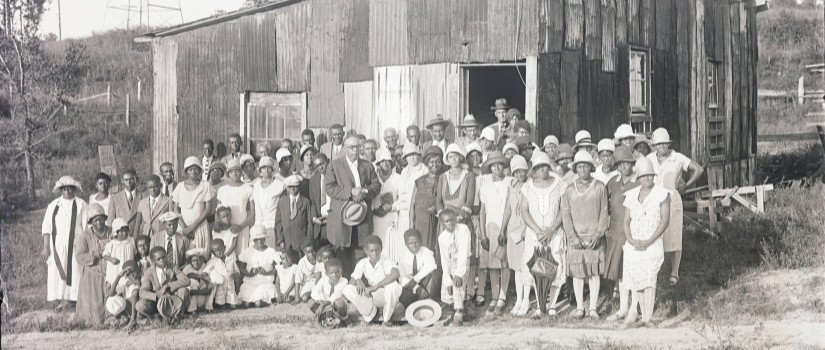
A vast collection of newly digitized glass plate photo negatives at University of South Carolina Libraries offers both community members and scholars the opportunity to explore the cultural, social and economic history of Columbia, SC’s Black community through images of its members.
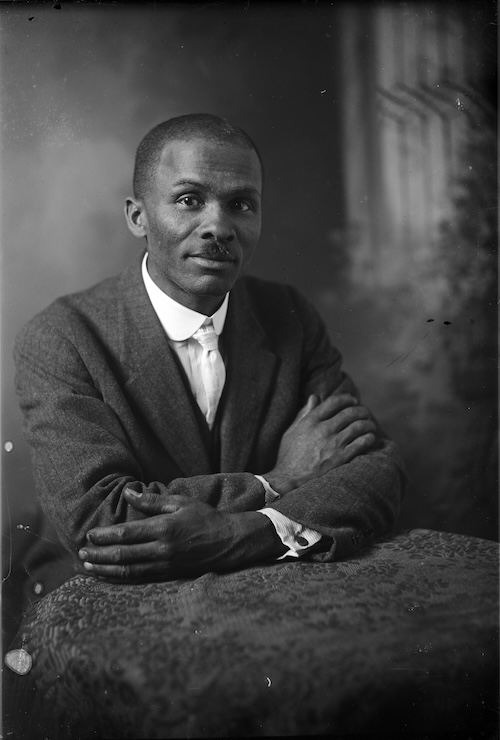
In 1920, Richard Samuel Roberts moved his family to Columbia, South Carolina, settling at a home on Wayne Street. From 4 a.m. until noon, he worked as a custodian at the US Post Office, earning a living to take care of his wife and five children. Once his shift was over, he would make his way to the photography studio space he rented on Washington Street in the heart of segregated Columbia’s Black commercial district to capture his community through glass plate negative photography.
Now, through the efforts of University Libraries and the Center for Civil Rights History and Research, over 5,000 of Roberts’ glass plate negatives detailing African American life in some of Columbia’s oldest neighborhoods in the early 20th century have been made freely and digitally accessible to the public for the first time ever, giving the city back a piece of its history that had largely been lost.
“The Richard Samuel Roberts collection is an astounding repository of African American History, certainly in the 20th century,” says Dr. Bobby Donaldson, Executive Director of the Center and Associate Professor of History at the University of South Carolina. “The preservation, archiving and digitization of the Roberts collection literally enables us to recreate and reconstruct lost chapters in the history of Columbia and South Carolina.”
The collection of glass plate negatives, housed at the South Caroliniana Library, has been made available through the Digital Collections at University of South Carolina Libraries. Though the collection was publicly discovered in the 1970s, it has not been accessible to the public unless individually requested by researchers or interested viewers.
In the 1970s, former South Caroliniana Library field archivist Tom Johnson worked with the Roberts family to remove the negatives from the crawlspace of the family home, where they had been stored, to the Library, where they could be preserved and maintained. The collection was officially purchased from the Roberts family estate in 2020.
Photos from the Roberts collection have been used in articles and exhibits over the years, including Intersections on Main Street: African American Life in Columbia at the Columbia Museum of Art, and even appeared in an episode of The Cosby Show. The collection was also the subject of a book, A True Likeness: The Black South of Richard Samuel Roberts first published in 1986 with a second edition in 2019. However, those publications only contain approximately 3 percent of the total images held in the Roberts collection. Furthermore, the fragility of the glass plate negatives made it virtually impossible for the everyday viewer to see all of the photographs in their intended state without advanced technology.
The Roberts images are the largest collection of glass plate negatives that the Libraries has digitized, according to Digital Collections Librarian Katie Hoskins. The Digital Collections team began working on the collection in early 2024 with support and funding from the Center for Civil Rights History and Research, which funded three of the four students who digitized the collection.
The glass plate negatives were scanned at a high resolution then touched up as needed to make sure the subject of the image was represented as best as possible. The results of the digital work alongside Roberts’ artistry is a collection of beautiful family and individual portraits that not only capture the people who posed for the camera, but also a more detailed and complete history and spirit of Columbia’s African American community during a critical time for Black culture in the United States.
“I tell people that Richard Samuel Roberts was not simply a photographer, he was an artist and he was also a historian,” says Donaldson. “He understood that one of his assignments was to tell a complete history of African American life in Columbia and in South Carolina, and he knew that he was telling a story that was against the prevailing narrative and stereotypes surrounding Black people.”
Rachel Young, Public Historian at the Center for Civil Rights History and Research, has been working on identifying the people and places that are in the collection beyond what the family could identify themselves. Some information had been collected by the previous efforts of Tom Johnson and the Roberts family, but many of the identities of people in the photos were unknown or contained unverified and outdated information that needed to be updated and polished for easy and accurate accessibility.
The photos also give a snapshot into aesthetics of the 20s and 30s, showing off the fashion and pride of African Americans living in the segregated Jim Crow south.
“What we are seeing when we look at these pictures is African Americans the way they wanted to be seen and remembered,” says Young. “Beyond its value to the archival and historical records, this collection also has value on a personal level for many people as well.”
The Honorable Michelle Hurley is one of those people who has personal connections with the Richard Samuel Roberts collection. Judge Hurley grew up in Columbia, and is a graduate of Heathwood Hall Episcopal School, Howard University, and the University of South Carolina School of Law. During her formative years, she worked at her family’s funeral home, collecting information from families of the deceased for obituaries. The Manigault-Hurley Funeral Home provided mortuary services to the African American community in Columbia for almost a century. Beyond taking photos for the Home’s advertisements and services, Roberts was also neighbors with Hurley’s great-grandparents.
Through her family, Hurley witnessed first-hand the impact that Roberts had in providing a narrative for the people who made up this thriving community of business owners, doctors, lawyers and more. “People wanted their stories told, so they went to Mr. Roberts,” says Hurley.
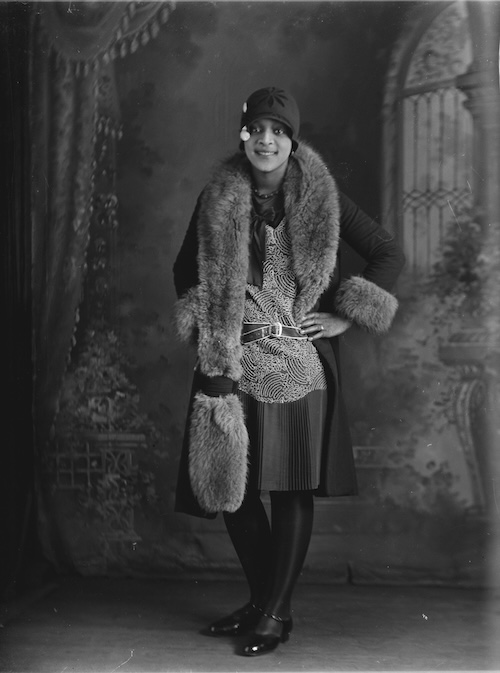
Besides the memories held by the geographic locations that Roberts photographed, Hurley can connect on a deeper level with her family’s history through the portraits. Featured in the collection are Hurley’s great-grandparents as well as her grandmother, Annie Mae Manigault-Hurley, who was the first female embalmer, white or black, to be licensed in the state of South Carolina.
“These photos tell the stories of people’s families, and help people identify their ancestors,” says Hurley. “They bring that history home so people can say ‘this is who I am, these are the people I come from.’”
The Center for Civil Rights and University Libraries hope that people continue to take part in the act of remembrance by identifying those they know in the photos.
“We know photographs have a way of piquing interest and stirring up memories in individuals,” says Donaldson. “These photographs push people to dig in the deep recesses of their mind and their memory, and they begin to recall details that probably would not come as easily without images to facilitate them.”
The digital collection features a box where viewers can submit identifications or notes that go along with images they see, making the work of remembering an ongoing and inclusionary effort between the University and the public.
One of Roberts’ surviving grandchildren, Judge Richard Warren Roberts, grew up in New York hearing stories about his grandfather from Roberts’ wife and other family members. Even so, he feels deeply connected to Roberts’ legacy and strongly believes in the power of his grandfather’s photographs to connect people to their past.
“It’s one thing to be able to get a two-dimensional paper with your ancestry on it, but it is another thing completely to be able to see your family members in photographs like these,” says Judge Roberts. “You can see the clothes they wore which could signal where they were employed, or what they did for a living. These kinds of revelations infuse people with a greater sense of self.”
Not only do the photographs connect people to their own past, but they connect communities who might otherwise not know much about each other, Roberts says. “People get the opportunity to look through a window into another community they hadn’t had the opportunity to look through before, and to see the humanity in people we thought we knew.”
The Richard Samuel Roberts Digital Collection can be accessed here.