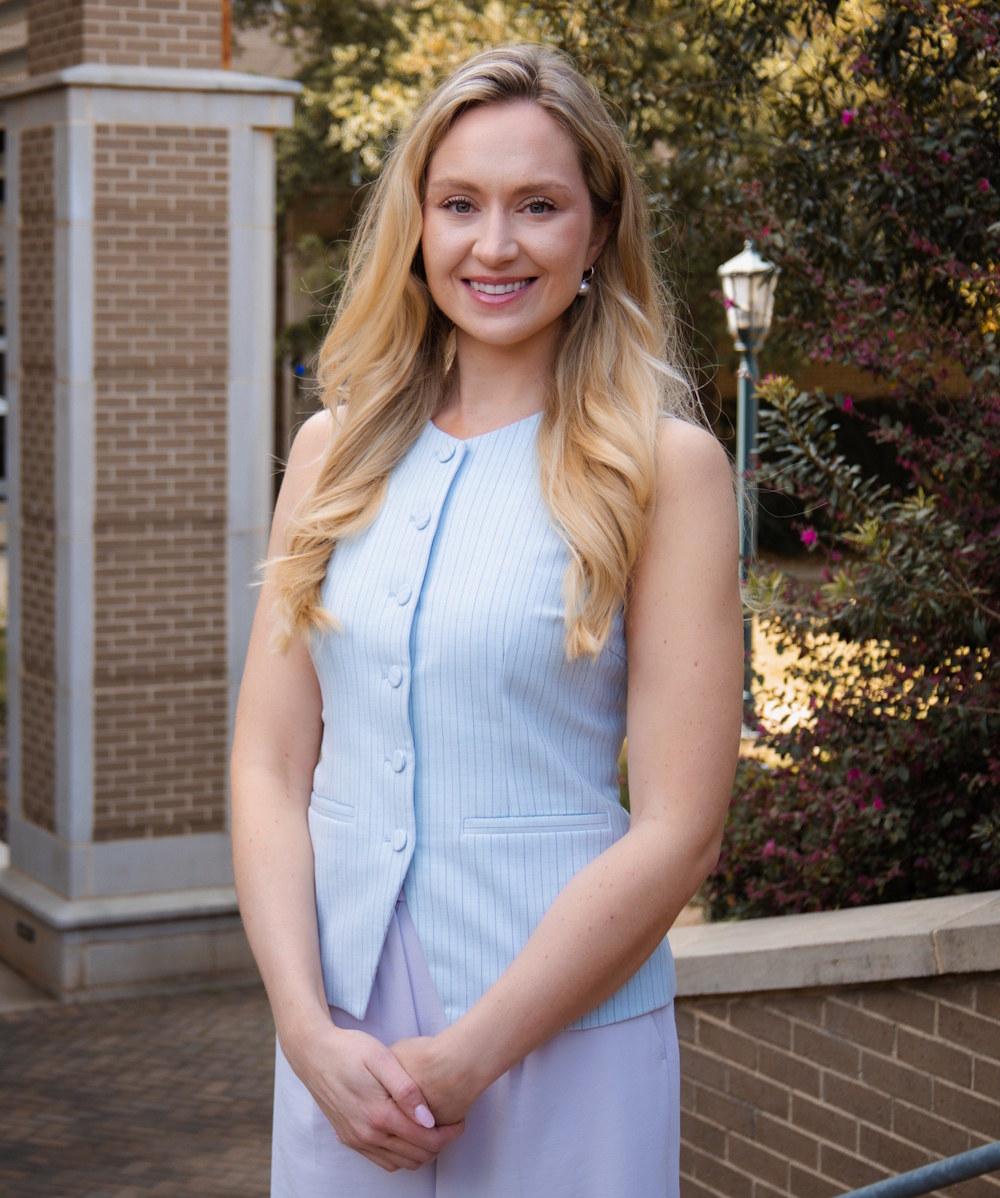
Olivia Finnegan first came to USC more than 10 years ago, and the growth of her scientific expertise
from college freshman to Ph.D. graduate is nothing short of remarkable. Over the past
decade, the Presidential Fellow built a strong research portfolio in children’s health
behavior research – particularly the technologies that can be used to more accurately
measure daily activities such as sleep, screen time and movement.
Her journey began when she moved to South Carolina from her small hometown in Rhode
Island to study exercise science. Finnegan’s interest in the field stemmed from her
role as captain of her high school lacrosse team, where she discovered she enjoyed
leading her teammates in off-season conditioning.
The Arnold Healthy Kids Initiative is an interdisciplinary group with faculty across
a wide range of expertise within children’s health. I think this type of group mentorship
style has provided me with an appreciation of team science and an understanding of
public health problems from a variety of perspectives.
Olivia Finnegan
She continued leading group workouts at USC as a fitness instructor with Campus Recreation,
which selected her as their Employee of the Year in 2018. The Capstone Scholar also
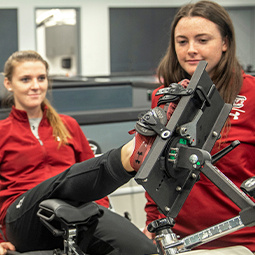
immersed herself in research – serving as a student research intern with the Children’s
Physical Activity Research Group in the Arnold School’s Department of Exercise Science and even becoming a Magellan Scholar by securing her own research grant. Meanwhile,
her coursework tied it all together, giving Finnegan a broader perspective and big-picture
framework.
“I was able to see this applied first-hand when getting involved during my freshman
year in Project Vida, a club at USC that volunteers with local transitional housing
communities and teaches children about nutrition, physical activity, personal hygiene
and other public health topics,” says Finnegan, whose service work enabled her to
graduate with Leadership Distinction in Professional and Civic Engagement. “It was
empowering to see the difference that a small group can make in the lives of the children
in this community and inspired me to think from a lens of prevention, which is something
that I’m continuing to do in my research now.”
After returning north to earn an M.S. in Kinesiology at the University of Rhode Island,
Finnegan began looking at doctoral programs. She had already had a front row seat
to witness the strengths of the Arnold School and the opportunities for hands-on research
when she was an undergrad. The national ranking of the Ph.D. in Exercise Science program and the chance to work with researchers at the Arnold Healthy Kids Initiative, which prioritizes mentorship and student-led research, cemented her decision.
Olivia Finnegan graduates in August with a Ph.D. in Exercise Science.
In addition to her Presidential Fellowship, Finnegan spent two years as an NIH T32
pre-doctoral research trainee with USC’s Behavioral-Biomedical Interface Program (BBIP)
while serving as a graduate research assistant across four NIH-funded projects led
by exercise science professor and Arnold Healthy Kids Initiative investigator Glenn Weaver. She also found mentors in Bridget Armstrong, Michael Beets, Elizabeth Adams and Sarah Burkart, who share the same faculty affiliations as Weaver.
“The Arnold Healthy Kids Initiative is an interdisciplinary group with faculty across
a wide range of expertise within children’s health,” Finnegan explains. “I think this
type of group mentorship style has provided me with an appreciation of team science
and an understanding of public health problems from a variety of perspectives. I feel
fortunate to have had a very positive mentoring experience, where I received a lot
of hands-on training and felt supported as a student. My mentors have played a central
role in shaping how I think critically, approach the scientific process, and evaluate
research.”
Finnegan even secured her own research funding, which she has used to support her
dissertation research. With support from a $125K F31 National Institutes of Health
grant, she is working to advance the measurement of child mobile device use to better
understand screen time among youth.
“Within the physical activity measurement space, I am interested in the harmonization
of accelerometry data using different accelerometry summary metrics,” Finnegan says.
“From a more applied perspective, I am also interested in contextual factors related
to healthier movement behaviors in children, with a focus on structured programming
like summer day camp.”
After graduating in August with more than 20 peer-reviewed publications to her name,
Finnegan will begin a postdoctoral fellowship with Brown University’s Cardiovascular
Behavioral Medicine T32 program as her next step toward becoming an independent investigator
at an academic institution. She says that her doctoral program has provided her with
a solid research foundation that she will continue to refine and apply throughout
her career.
Finnegan also speaks fondly of her second time living in Columbia – a very different
but equally enjoyable experience now that she is married and leaning into more of
the community offerings such as the riverwalk and local restaurants. She has particularly
valued her involvement in the Presidential Fellow and BBIP programs, which have connected
her with students from disciplines across USC as well as helped her advance her research
skillsets and professional development opportunities.
“Identify the types of skills that you want to build during your Ph.D. training and
make sure your program’s training is aligned with your long-term career goals,” Finnegan
advises students considering a doctoral degree. “Talking to graduate students within
the program or specific lab that you are interested in working with can be very helpful
during the application process as well.”