Rachel Gressick first discovered that reproductive health could be political when she was growing
up in small town outside of Louisville, Kentucky. As early as middle school, she began
writing about and debating health-related proposals through her participation in Kentucky’s
Model Congress and United Nations.
As the political and policy environment has become more turbulent, I feel motivated
to study reproductive health behavior and learn to become a better advocate for reproductive
justice.
Rachel Gressick
Gressick can clearly recall when her state’s legislature proposed a trigger ban on
abortion during her sophomore year of high school. The law was later passed and enacted
after Roe v. Wade was overturned.
“I attended the house committee hearing, listening as health care professionals, community
leaders and women with very personal stories spoke on each side of the aisle,” she
says. “This experience stuck with me, and every time reproductive health is mentioned
in the news or in political debates, I consider the factors that could have influenced
each argument. As the political and policy environment has become more turbulent,
I feel motivated to study reproductive health behavior and learn to become a better
advocate for reproductive justice.”
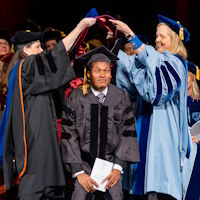
Rachel Gressick graduates this month with an MPH in Health Promotion, Education, and
Behavior.
After studying public health and economics at the University of Kentucky – where she
gained research experience contributing to an NIH-funded study focused on addiction
treatment services – Gressick decided to pursue a Master of Public Health (MPH) degree
to continue learning about health behavior research. She chose the Arnold School’s
MPH in Health Promotion, Education, and Behavior (HPEB) because it offered top-notch resources, opportunities and mentorship at an
R1 institution.
The Ann Cassidy Endowed Fellow found a mentor in HPEB assistant professor Marta Bornstein, whose research interests in sexual and reproductive health, including fertility,
infertility, contraceptive use and abortion, overlapped with Gressick’s. For the past
18 months, they have been working together to better understand fertility care decision-making
among sexual and gender minority adults.
“Through this study, I have had the opportunity to learn from Dr. Bornstein about
in-depth interviewing techniques, participant recruitment and qualitative data analysis,”
says Gressick, who plans to continue this work as a student in the Ph.D. in HPEB program.
“I am immensely thankful for her mentorship and for her continued support as my advisor
while I further my education in the doctoral program.”
Having grown up in the South, Gressick is particularly interested in these areas of
research within the context of the Southeastern United States due to the cultural
and political influences – as well as their consequences – within the region. With
plans to advance reproductive health and justice by working at a government health
agency or nonprofit organization, she believes that her training at USC will prepare
her to inform evidence-based public health policies and programs.
Signing up for several more years at USC was an easy decision as Gressick has always
loved SEC campus culture – from sporting events to Greek Life, which she now gives
back to as an advisor – and the opportunity to live in the state’s capital city.
“There is something special about such a large student body and alumni network coming
together to support our teams, whether it’s women’s basketball at Colonial Life Arena
or football at Williams-Brice Stadium,” she says. “Beyond the campus environment,
I have enjoyed living in Columbia because of the opportunities to learn and engage
with local culture, like visiting the Columbia Museum of Art, which has an impressive
permanent collection and a diverse selection of rotating exhibitions.”