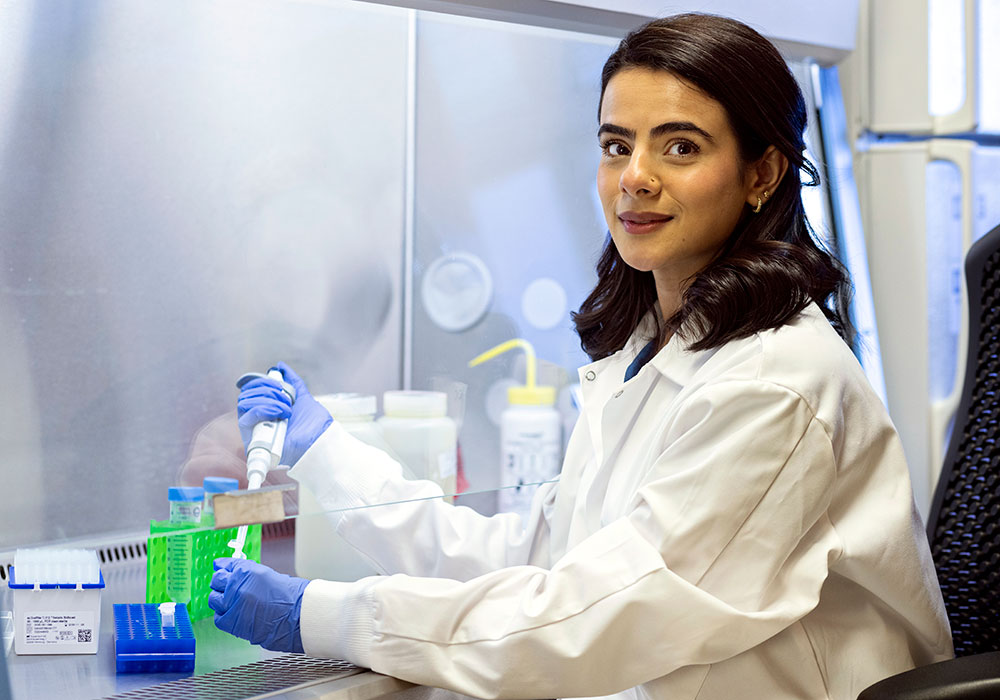
As an applied biosciences major in her home country of Pakistan, Syeda Shehirbano Akhtar envisioned a life in the lab. But an internship detecting diabetes genes in blood samples changed her perspective — and the trajectory of her career.
“After a certain point,” Akhtar says, “the samples stopped being samples for me, and I felt like every tube on the rack was a person waiting somewhere for an answer.”
She was also struck by the lengthy timeline between symptom onset and laboratory testing — if healthcare access issues, stigma or other potential barriers didn’t derail the process altogether.
“By the time the sample had reached the lab, somebody had already noticed that they were sick and decided to do something about it, found the clinic and got themselves checked,” she says. “That’s a very long chain, and a lot of people fall off of it because they become a data point.”
More than a decade later, Akhtar is a Fulbright Ph.D. Scholar at the University of South Carolina’s Arnold School of Public Health. Her dissertation research, which is supported through a grant from the American Sexually Transmitted Diseases Association, will help public health agencies better gauge sexually transmitted infection rates at the population level, even among people who aren’t accounted for in clinical systems data.
Thanks in large part to the mentorship she has received at USC, she has developed the necessary skills to not only conduct this type of research but translate her findings into actionable insights.
“I really want to keep working at the seam between the laboratory and the policy table,” she says. “I feel like there are excellent lab scientists developing detection methods, and then there are excellent policy makers who need better data. I think the transition between them is very thin. That’s the work I want to do.”
How wastewater-based epidemiology works
In the months after COVID-19 upended daily life, a little-known surveillance technique entered public consciousness: Wastewater-based epidemiology testing.
The practice isn’t new. Targeted sewage testing has long been used to gauge community infection trends for polio and other viral illnesses. But thanks to the development of large-scale infrastructure to track COVID, it is now feasible to monitor other pathogens — including sexually transmitted infections — at the population level. The challenge for public health agencies is to refine their detection methodology.
That challenge appealed to Akhtar. During the four years she worked for the World Health Organization after earning her master’s degree, she observed what modern surveillance methods could and couldn’t do. Clinical data provided valuable insights on infection rate trends. But as she had noted previously, it only captured people who had engaged with the healthcare system. Wastewater data provided a more complete picture of overall infection rates and patterns but isn’t intended to function as a standalone metric.
“Wastewater surveillance is only effective, and can only be used to its full potential in parallel with clinical surveillance, because it won’t tell you who’s infected in the community,” she says. “It cannot pin down the individual. It won’t give you age or sex or all the demographics of the patient. And nobody gets treated from a wastewater signal, so you still need that clinical signal. It’s more like a smoke detector, not a diagnosis.”
COVID turned out to be relatively trackable in wastewater. But viral and bacterial pathogens are two very different things.
“I really want to keep working at the seam between the laboratory and the policy table. I feel like there are excellent lab scientists developing detection methods, and then there are excellent policy makers who need better data. I think the transition between them is very thin. That’s the work I want to do.”
“Bacterial STIs like chlamydia, gonorrhea and syphilis are much harder to detect because they are present in very tiny quantities,” she says. “And their DNA degrades on the way through the sewer system.”
Additionally, there isn’t much literature on what a reliable signal, or measurable concentration, would look like when testing wastewater for STI pathogens, particularly syphilis, which exists in even smaller amounts. To help agencies better track these infections, pioneering researchers like Akhtar must first distill the process into a how-to guide. Much of her dissertation research has involved assessing the effectiveness of available pathogen testing kits.
“This isn’t just run the sample and report the numbers,” Akhtar says. “It’s also about building that mechanism first where you are also standardizing your protocol and looking at, ‘OK, what step could I change in order to make the STI-targeted pathogens more detectable? How can I improve the efficiency of the whole process?’”
A transformative mentorship
As part of her application to the Fulbright Ph.D. Scholars program in 2021, Akhtar explored which U.S. universities best aligned with her interests in infectious disease research and health systems strengthening. And that’s how she stumbled across associate professor Banky Olatosi.
“When I started looking up more of Dr. Banky’s research group’s work,” she explains, “I felt like it wasn’t just health policy perspective. It’s also health promotion and behavior, epidemiology and biostats. There were so many collaborators on each of the papers, which was really interesting because then you are looking through a very wide lens and approaching different problems from different angles. So many expert opinions are involved that you end up producing actual research that can make a difference.”
Since coming to USC, Akhtar has dug deeper into the policy sphere. Her health policy fellowship with the Healthcare Information and Management Systems Society has given her the opportunity to weigh in on transforming rural health and how AI is governed in healthcare.
And with Olatosi’s guidance, she has learned how data can be used as a policy instrument, not just as an analytical one.
“Every design choice for my particular research project, like which sewershed, how to present the results, how to determine whether the results are something that a health department can act on — on every step, he asked me, ‘So, what would you do differently to make it a more usable instrument for actual decision makers?’” she says. “He kept challenging me through every step.”
While Akhtar and Olatosi often conduct research differently — one works at the molecular level in the lab and the other specializes in big data health science — the mentee says having a mentor who could shift her perspective from practitioner to researcher was far more valuable than having a mentor who could run an assay.
“My instinct coming out of five years of consulting experience was to move fast and produce something usable,” she says. “His discipline pushed me the other way. He made me learn how to prove something, validate it and know your limitations before you publish, because the moment a health agency makes a decision on your reporting, you own the consequences of it being wrong as well.”
What makes Akhtar stand out as a researcher? Olatosi believes it’s her ability to see beyond the lab and recognize how scientific discoveries can impact health at the population level.
“As a mentor, my greatest hope is not simply to help students become accomplished researchers, but to empower them to become independent leaders who challenge conventional thinking and create new possibilities,” Olatosi says. “Shehirbano is already demonstrating those qualities, and I have every confidence that her contributions will extend far beyond her doctoral research.”