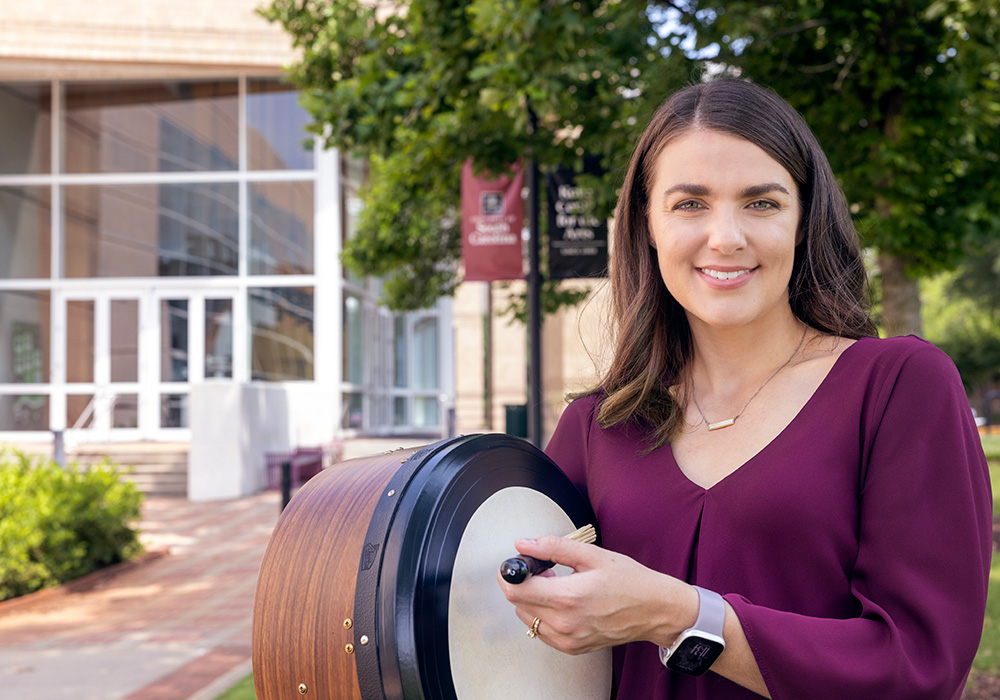
Music has shaped Alexandria Carrico’s life since childhood. From voice lessons to listening to traditional Irish music with her family, she developed an understanding of what “sounded good.” It wasn’t until college that she rediscovered music through a new lens — one that challenged her earlier training and introduced her to ethnomusicology: the study of music in its cultural context.
That moment of reconnection would ultimately shape her academic path and led to her current work at the intersection of traditional Irish music and disability studies as an assistant professor in the University of South Carolina's School of Music.
Carrico’s master’s thesis connected her to musicians with Williams syndrome, which is a genetic condition that impacts multiple aspects of an individual’s development and health. She noticed that the collaborative nature of traditional Irish music helped create interpersonal connections and break down barriers between people with and without disabilities.
While Carrico’s background as a performer shaped her research and teaching immensely, her early training created a limited understanding of what was musically possible or acceptable. Working with musicians with disabilities recalibrated her ears and taught her to listen broadly for connection and creativity. She credits this experience with saving her love of music. In the classroom, she encourages her students to listen generously and expand their understanding of what is musically valuable.
“Once you challenge some of the assumptions that we automatically inherit, you begin to realize you're not just listening to music, you're listening to people,” Carrico says.
Home for harmony
Carrico’s work eventually took her to Ireland, where she organized traditional Irish music workshops for adults with intellectual disabilities. The group met to sing and use percussion instruments, then took those skills to performances in the community. “The goal was to remove the power dynamic often present in interactions between people with and without disabilities, the kind where someone’s motivation is volunteering with an organization, which is wonderful,” Carrico says. “But this was about bringing musicians together on equal footing.”
A misconception about Carrico’s work is that she is a music therapist. While she has collaborated with music therapists in the past, their goals are quite different. Music therapy is using music to accomplish non-musical goals, often with a specific individual. Whether it be mood regulation, pain mitigation or academic goals, the focus is on how they can remediate something within this person.
Once you challenge some of the assumptions that we automatically inherit, you begin to realize you're not just listening to music, you're listening to people.
Carrico approaches her work with a different perspective. She seeks to find how musical interactions can overturn stereotypes and misconceptions of neurodivergent people, while creating connections that explore humanity and the diversity of the human experience.
In the classroom, Carrico incorporates her knowledge on multiple levels. Classes like Music and Disability Studies cover topics from disability legislation in the United States to composers that had disabilities and how it impacted their music. Much of her teaching is informed by making spaces and ideas accessible for everyone.
Every semester, she includes a section in the syllabus acknowledging the barriers that people may face when receiving accommodations, such as late diagnosis, or fear of discrimination. Carrico invites students to communicate anything they need to succeed without the pressure of disclosing a reason. This open-door policy helps students take ownership of their educational experience.
Freedom to create
One of Carrico’s dream projects is a free community music program that eliminates financial barriers and welcomes participants with disabilities of all ages. The program would focus on process-based music-making like improvisation, songwriting and composition, and it wouldn’t require prior musical experience. Facilitated by music education students at USC, community educators and eventually even past participants, the program would serve as both a hands-on learning opportunity for future teachers and a creative, inclusive space for the community.
Carrico is currently working on a book project that delves into the idea of musical talent versus neurodivergent musicality. Where do our ideas of musical talent come from and who decides these things? She plans on juxtaposing the traditional ideas of musical talent with the work she has done with neurodivergent musicians, showing the different way that these musicians engage and interact with music.
“Maybe it doesn't conform to what we think of as musical talent, like replicating a pitch or rhythm, but there's something interesting happening here,” Carrico says. “There's a lot of creativity, a lot of improvisation, and if we can listen that way and find it valuable, then how might that change the way we teach and interact with students?”