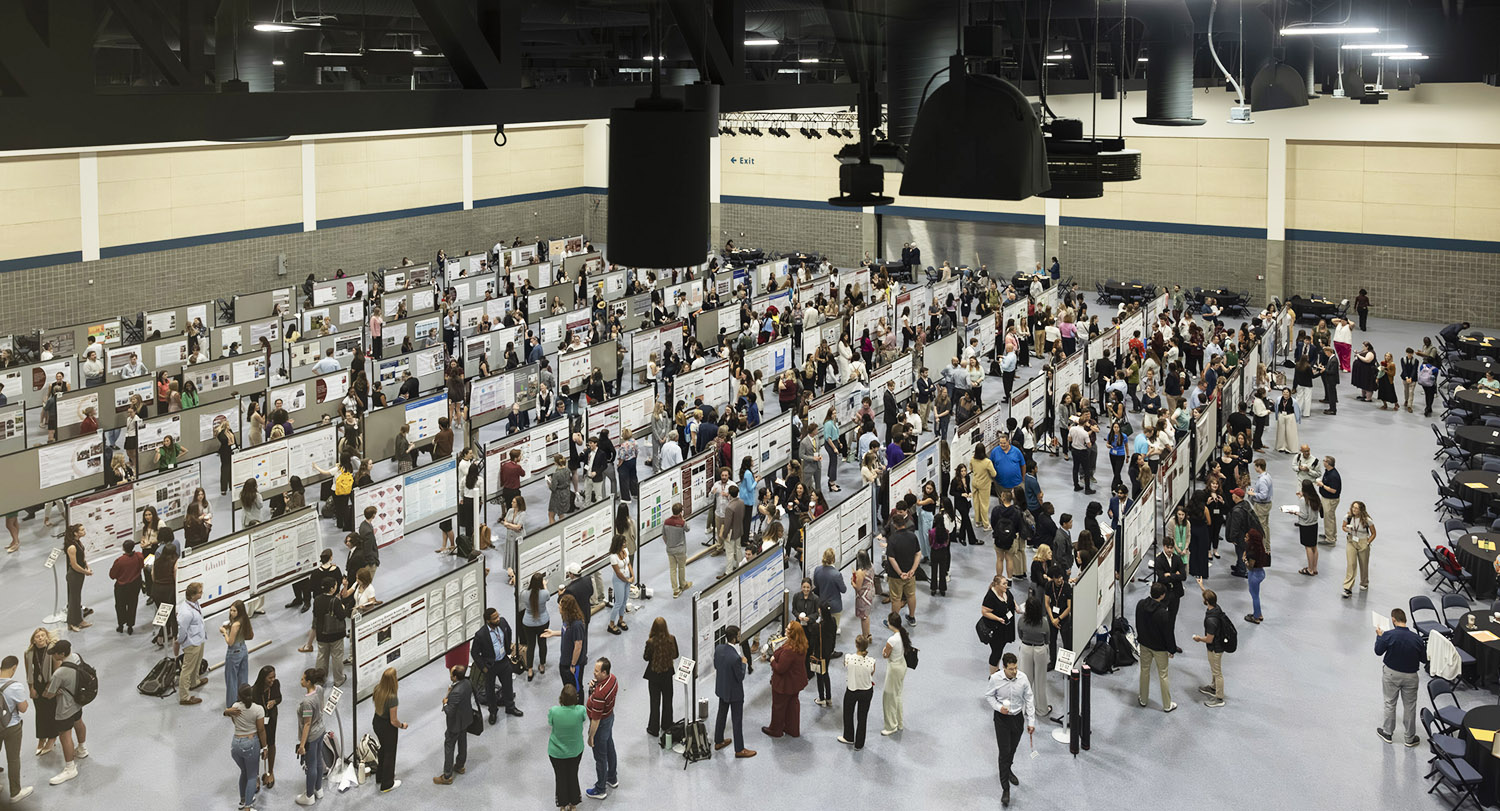
Each year, Discover USC presents more than 1,000 research projects covering hundreds of subject areas and students from all areas of the university, including undergraduate and graduate students, medical scholars and postdocs. Each of those students works with faculty mentors to explore topics that interest them, learn more about research skills and work on how to present their findings to an audience.
As this year’s Discover USC approaches on April 24, we reached out to a student who took part last year to learn more about what the experience was like.
A junior from Greenville, South Carolina, Ansley Martin is a neuroscience major in the McCausland College of Arts and Sciences and a Goldwater Scholar.
How did you get involved in Discover USC last year?
I got involved in Discover USC last year because I had been granted the Magellan Scholar Award for spring 2025. As a part of that grant, I committed to disseminate my work at Discover USC 2025. I also presented at Discover USC in 2024. Every year, I receive phenomenal feedback from experts in diverse fields and make so many connections. When I presented in 2024, I met Dr. Alex Reynolds, who invited me to take her class on the psychology of sleep, which is one of the most interesting classes I have taken as an undergraduate.
What is the project you’re working on this year?
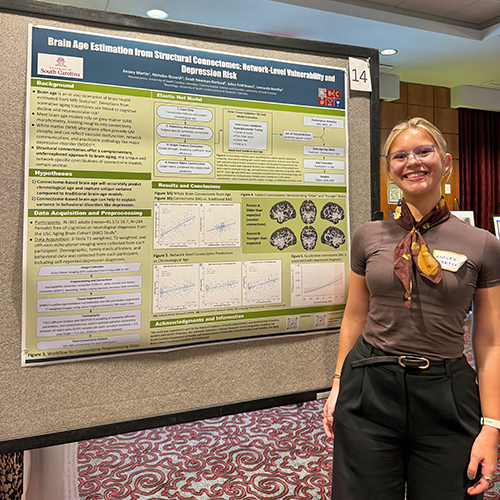
The project I pursued this year and am presenting at Discover USC 2026 is called “Brain Age Estimation from Structural Connectomes: Network-Level Vulnerability and Depression Risk.” The research topic I investigate is “brain age,” an in vivo MRI-based biomarker of brain health. Accelerated brain age is related to an increased risk of cognitive decline, neurovascular disease and even psychiatric conditions. However, most traditional models use grey matter morphometry, which can limit insights into how brain connectivity influences brain health.
Since November, I have been working on a machine learning model that predicts chronological age from patterns of white matter connections, called connectomes. Our model accurately predicts chronological age; the gap between the model’s prediction and the individual's chronological age (brain age gap) can then be used to predict behavioral outcomes like depression. Accelerated connectome aging significantly predicted depression, whereas highly validated grey matter-based models did not, demonstrating the potential utility of connectome aging models.
“Have fun with it. This is not a test, but rather a celebration of your hard work and an opportunity to receive insightful feedback. Practice a few times with your roommates or friends, so you feel comfortable, and then go crush your poster presentation... This is your chance to make an impact.”
What did you learn about yourself through this process?
Throughout this process, I learned that I am capable of innovation even as an undergraduate. I am very fortunate to have mentors like Dr. Nicholas Riccardi and Dr. Leonardo Bonilha, who push me to explore my interests and develop novel, cutting-edge projects. As someone without a traditional biostatistics or computer science background, I was definitely intimidated by taking on this project, but in the end, I developed the skills I needed to successfully design the model and learned far more than I anticipated. Overall, I feel a lot more confident in the realm of computational neuroscience and am excited to see which boundaries I can push next.
What advice would you give to a student who is participating for the first time this year?
The advice I would give to a student who is participating in Discover USC for the first time is to have fun with it. This is not a test, but rather a celebration of your hard work and an opportunity to receive insightful feedback. Practice a few times with your roommates or friends, so you feel comfortable, and then go crush your poster presentation. My tips for the day of: Wear something comfortable; don’t read off your poster but use it as a visual aid; be mindful of your body language and facial expressions; and never assume who you’re speaking to is an expert in the field. This is your chance to make an impact.