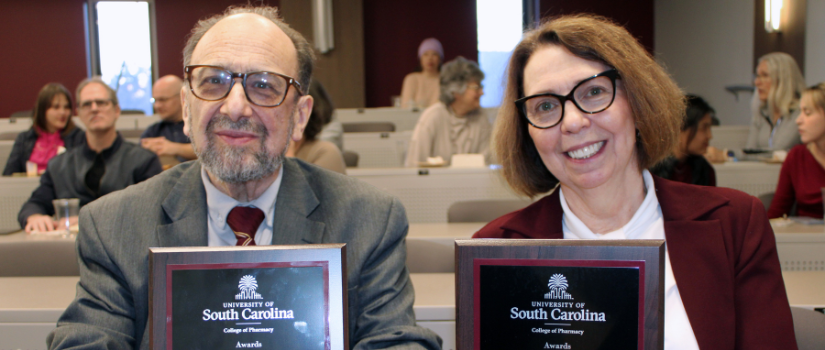
After more than a decade of shaping cancer research at the USC College of Pharmacy and throughout the scientific community, Dr. Eugenia Broude and Dr. Igor Roninson are closing the chapter on their academic careers — together.
“We’re ready to separate work from life and live a little,” says Roninson, who joined the South Carolina College of Pharmacy in 2011 as the Endowed Chair in Translational Cancer Therapeutics. Broude, his longtime collaborator and spouse, agrees: “Of course, to run it into the ground, we decided to retire together.”
The pair emigrated from the former Soviet Union and built distinguished careers in cancer biology. Roninson, a Moscow native, earned his Ph.D. at Massachusetts Institute of Technology and later became internationally recognized for research on multidrug resistance, chemotherapy-induced senescence and functional genomics. Broude, who was born in Ukraine, conducted the research in neuroscience and then became Roninson’s key partner in advancing translational therapeutics.
Their decision to retire is bittersweet. “We really love our team. It’s a family,” says Roninson. “We’ll miss the atmosphere — the big pharmacy family.” Still, they leave behind a strong legacy. “It was very important to arrange the transition,” Broude adds. “We made sure to leave no one unattended.”
Looking ahead, family and travel top their list. “The principal place is Boston, which is kind of the center of our family life,” Broude says. Roninson, who has a great love for Greek and Roman art and history has another dream.
“Eugenia found a job for me — to be a docent at the Museum of Fine Arts in Boston,” he laughs.
Even as they step away from full-time roles, Roninson and Broude, who have each received the designation of ‘professor emeritus,’ emphasize that their ties to the College of Pharmacy remain.
“We’re not disappearing,” says Roninson. “We’ll be here to advise colleagues working with our drug, help our colleagues prepare their publications, and support students through their Ph.D. committees.”
“We feel at peace knowing the transition is complete,” Broude continues, “but we’ll always be available to help whenever needed.”
Their emeritus status ensures that, while their lab lights may dim, their guidance and expertise will continue to shine for the next generation of scientists.