Every process creates expectations – whether intentionally or not. When those expectations don't match reality, customers are surprised. Those surprises reveal where a process is more confusing, more complicated, or simply different from what customers expected. By capturing those moments in one place, the customer surprise wall helps teams identify where expectations, communication, or the process itself need to change.
Materials needed: Sticky notes, markers, a wall or large flat surface
Time needed: 45-60 minutes
Works well for: Any unit where customers seem caught off guard by how a process works, how long it takes, or what's expected of them. Especially useful as a quick starting point before using the Customer Experience Map for a deeper look
Before you begin: No preparation needed. This technique works best when it draws on real experiences – the goal is to capture what customers have actually been surprised by, not what the team assumes they might find surprising.
Visual example:
Click to expand – will open in a new window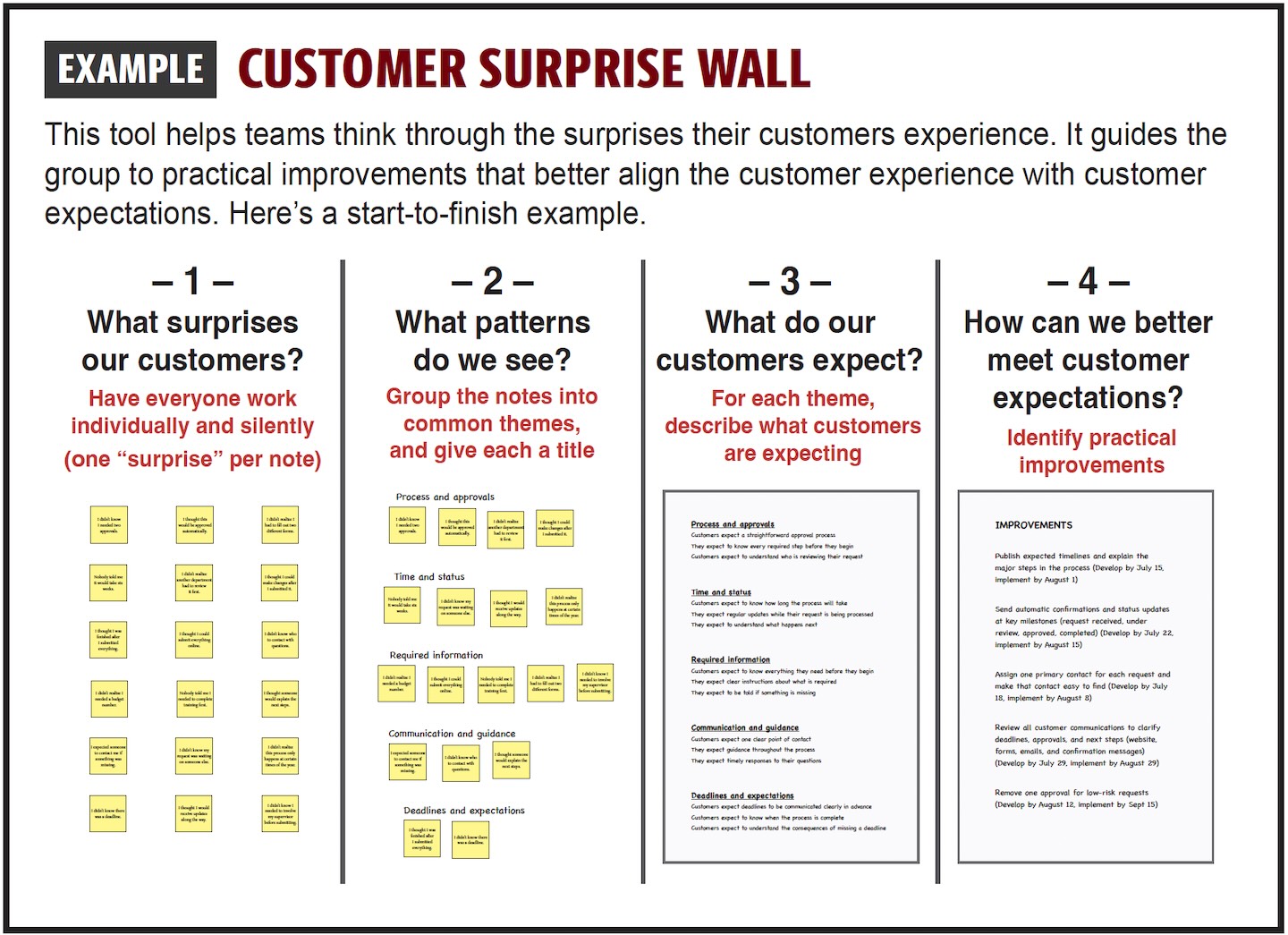
Step by step:
1. Set the scene: Ask the group to think about the moments when customers have seemed surprised, caught off guard, or caught unaware by something about the process. Not complaints exactly – but moments of "I didn't know that" or "I didn't expect that" or "nobody told me." Give everyone a stack of sticky notes and a marker.
2. Write the surprises: Have each person write one customer surprise per sticky note – as many as they can think of in about five minutes. Write them in the customer's own words where possible. "I didn't know I had to submit two forms." "I didn't realize it would take six weeks." "Nobody told me the deadline was firm." The closer to the actual experience, the more useful this step will be.
3. Cover the wall: Have everyone post their notes on the wall without organizing them yet. The volume is itself a finding – a wall covered in surprises is a picture of how many unmet or unspoken expectations exist between the unit and the people it serves.
4. Group the surprises: As a group, move the notes into themes of related surprises. Common themes might include surprises about how long the process takes, surprises about what information or materials are required, surprises about what happens after submission, surprises about who is responsible at each stage, and surprises about deadlines or consequences.
5. Name the themes: Give each theme a short label that describes the underlying expectation behind the surprises. Ask, "What were customers expecting that didn't happen?" or "What expectation wasn't met?" Then, for each grouping, briefly describe what customers were expecting. Examples might include: "Customers expect the process to move more quickly." "Customers expect to be finished after submitting." "Customers expect us to contact them if something is missing." "Customers expect to know what happens next." These labels point directly to where expectations, communication, or the process itself need to change.
6. Identify next steps: Looking across all of the themes, ask the group: Which expectations are most important to address first? Which improvements would have the greatest impact on the customer experience? Focus on a small number of realistic changes the group can make in the next 30 days. Capture each commitment with an owner and a timeframe before the group concludes.
Before you leave the room, make sure the following are captured: the key themes, the improvements the group is committing to, who owns each one, and their target completion dates. Take a photo of the on-the-wall materials before they come down.