Customers often reach out because they have a question, aren't sure what to do next, or can't tell where things stand. The customer contact wall helps teams identify the questions they receive most often, understand why customers are asking them, and decide how to handle them – including how to provide information in advance so customers don't have to ask.
Materials needed: Sticky notes, markers, a wall or large flat surface
Time needed: Approximately 90 minutes
Works well for: Any unit that regularly receives customer inquiries and wants to respond more consistently while reducing unnecessary contact.
Visual example:
Click to expand – will open in a new window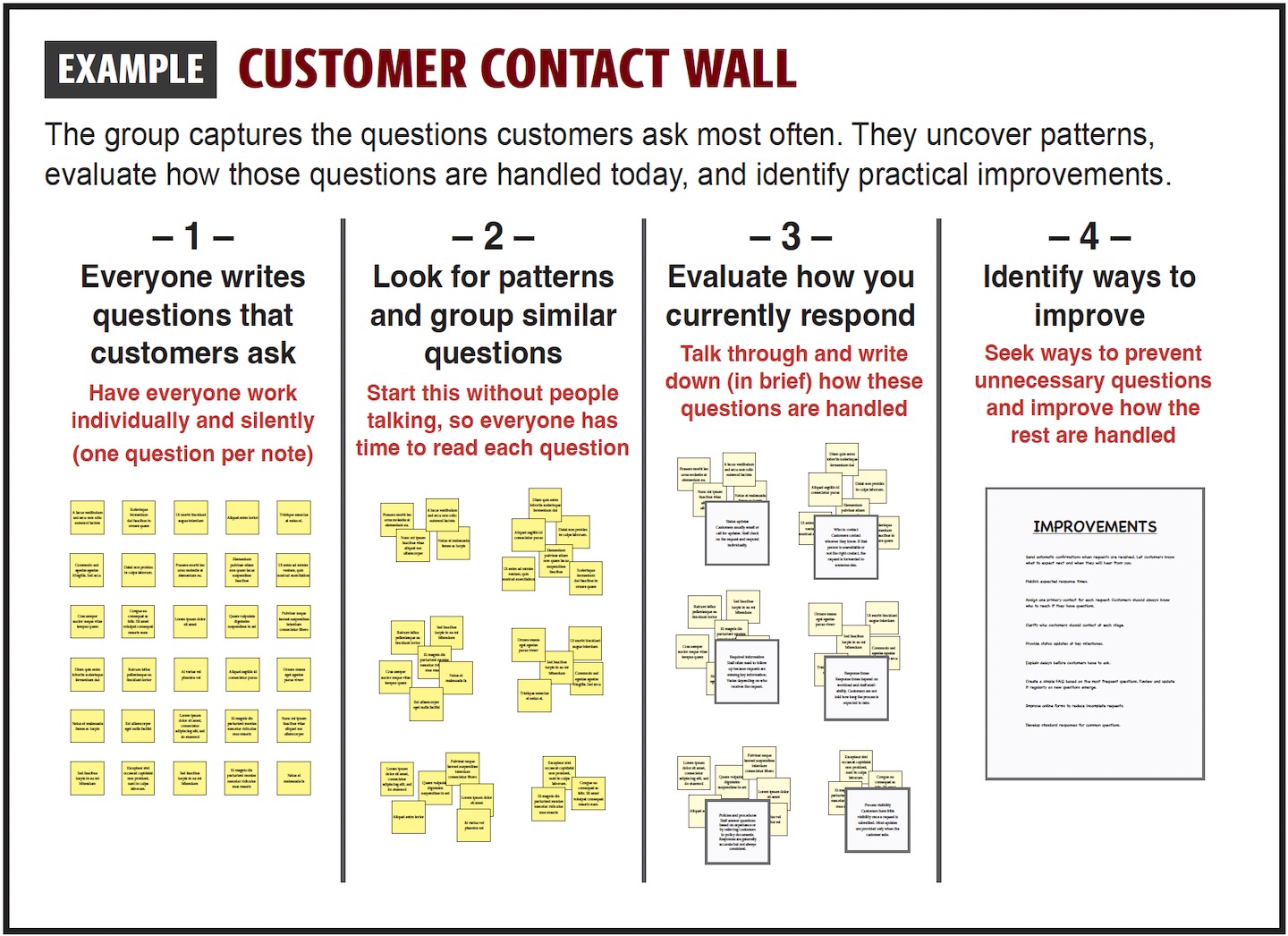
Step by step:
1. List the questions: Individually, each participant writes one customer question per sticky note and posts it on the wall. Focus on questions about the process – not the technical details of the work. Write the questions in the customer's own words, not paraphrased. "Did you receive my request?" is more useful than "customers ask whether we received it."
Common examples: Did you receive my request? Who has it now? How long will this take? What happens next? Is there anything else you need from me?
Once everyone has finished, post the sticky notes on the wall without organizing them. The volume itself is a finding – a wall covered in questions is a picture of how much uncertainty customers are carrying around.
2. Group and label the questions: As a team, group similar questions together and give each group a short label. Then, for each group, ask: What is the customer really trying to know? Most questions are really requests for reassurance, visibility, or direction. Recognizing that underlying need helps the group identify patterns.
3. Evaluate how you currently respond: Discuss how the unit handles each group of questions today. Is the response consistent, or does it depend on who answers? Are customers being transferred unnecessarily? Are there gaps where no one owns the response?
4. Reduce unnecessary inquiries: For each group, ask: How could we answer these questions before customers have to ask them? Consider confirmation emails, clearer instructions, status updates, proactive outreach, or better information on your website or in your process.
5. Clarify how customers should get help: For the inquiries that will continue to come in, decide how customers should reach you. Should there be one point of contact, or different contacts at different stages? Who should customers ask for, and how should they reach that person? Then decide how those inquiries should be handled. What core information should every customer receive? Where is consistency most important – and where should staff have flexibility in how they respond? Write down what the group agrees on.
Important: This conversation can run long. Stay focused on practical decisions the group can make today rather than debating every possible scenario or exception.
6. Commit to action: Identify a small number of improvements the group will implement. For each one, assign an owner and set a realistic timeframe.
Before you leave the room: Capture the major groups of questions, the unit's agreed-upon contact approach, and the improvement actions with owners and timeframes. Take a photo of the wall before it comes down.