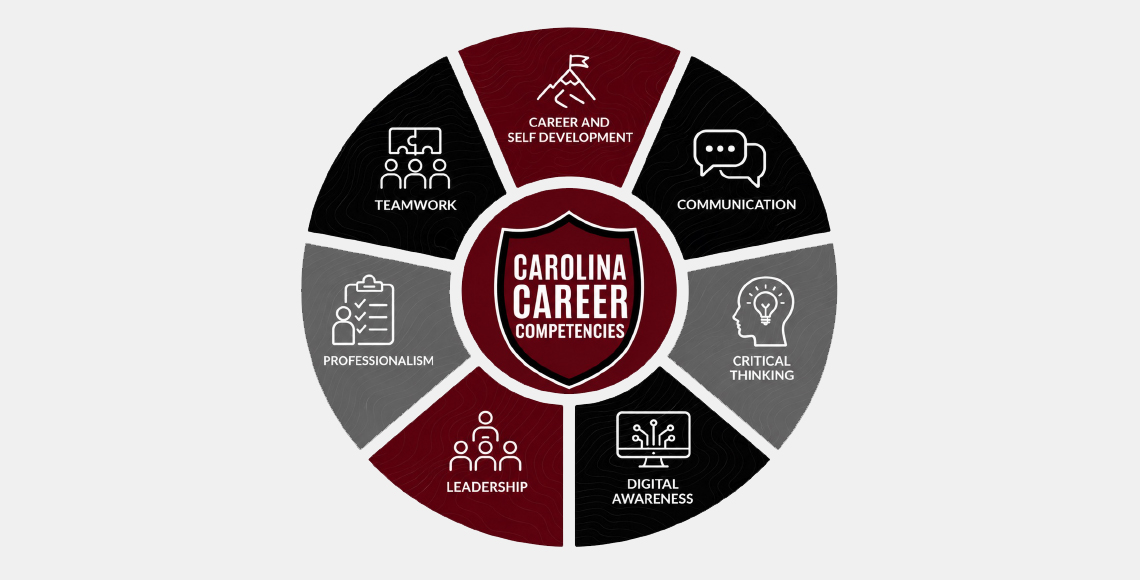
As a student at the University of South Carolina, you'll have opportunities to develop these competencies through your coursework, internships, research, student organizations, leadership roles, campus employment, volunteer service, and other experiences both on and off campus. By intentionally building these skills throughout your time at Carolina, you'll be better prepared to achieve your goals, confidently navigate the job search, and make a meaningful impact in your future career.
USC Career Competencies
Career & Self-Development is proactively developing oneself and one’s career through continual personal and professional learning, awareness of one’s strengths and areas for growth, navigation of career opportunities, and networking to build relationships within and without one’s organization.
Develop it!
You can strengthen your career & self-development by:
- Meet with a Career Coach to develop a personalized Career Plan.
- Participate in internships, undergraduate research, student employment, or other experiential programs.
- Attend Career Fairs and Career Networking Events.
- Utilize premium resources, such as Handshake, V-Mock, and campus resources
- Seek out campus student leadership opportunities, such as Student Government, Residential Assistants, Orientation Leaders, or become involved as a leader of a registered student organization.
Express it!
Show employers your career & self-development skills by talking about times when you:
- Conducted informational interviews with professionals and alumni to explore career paths, expand industry knowledge, and build professional connections.
- Sought and applied constructive feedback from supervisors and faculty to strengthen performance, develop new skills, and improve outcomes.
- Demonstrated continuous growth by developing and applying new technical, leadership, and professional skills through coursework, employment, and campus involvement.
- Led teams and initiatives by serving in leadership roles, coordinating events, managing projects, and motivating others to achieve shared goals.
- Evaluated experiences and applied lessons learned to set goals, make informed decisions, and support ongoing personal and professional development.
Communication is the ability to share information clearly and effectively with others. It includes speaking, writing, listening, and adapting your message for different audiences. Strong communication helps you express your ideas, understand others, and contribute meaningfully in academic, campus, and professional settings.
Develop it!
You can strengthen your communication skills by:
- Participate in discussions by contributing ideas, asking questions, and responding thoughtfully
- Write clear emails, assignments, and messages with clarity and purpose
- Listen actively, focusing on understanding before responding
- Explain concepts fully to all parties
- Adapt your tone, adjusting language and style depending on audience
- Resolve misunderstandings, clarifying expectations and navigating conflict
Express it!
Show employers your communication skills by talking about times when you:
- Presented research findings to classmates and faculty using clear, audience-appropriate language.
- Wrote professional emails to campus partners to coordinate project details.
- Adapted communication style to support peers during tutoring and mentoring sessions.
- Facilitated group discussions by asking questions and summarizing key points.
Critical Thinking is the ability to carefully evaluate information, ask thoughtful questions, and consider different perspectives before making decisions or solving problems. It helps you use evidence and logic instead of assumptions, so you can make informed choices with confidence.
Develop it!
You can strengthen your critical thinking skills by:
- Gathering information from a variety of reliable sources before reaching a conclusion.
- Breaking complex problems into smaller, manageable steps and identifying possible solutions.
- Analyzing data and evidence while recognizing how your own experiences and assumptions may influence your thinking.
- Reflecting on your experiences by asking what worked, what didn't, and what you would do differently.
- Taking courses that emphasize research, analysis, and problem-solving.
- Participating in undergraduate research, case competitions, or campus projects.
- Joining student organizations and helping solve challenges or improve programs.
- Completing internships, part-time jobs, volunteer experiences, or job simulations where you solve real-world problems.
- Meeting with a Career Coach or completing LinkedIn Learning courses to strengthen your decision-making and analytical skills.
Express it!
Show employers your critical thinking skills by talking about times when you:
- Analyzed information from multiple sources before making a decision.
- Solved a complex problem by evaluating different options and recommending a solution.
- Used data or evidence to support your ideas or decisions.
- Identified challenges and developed creative or practical solutions.
- Reflected on feedback or project outcomes to improve future performance.
- Balanced competing priorities and adapted your approach when situations changed.
- Considered different perspectives when working with classmates, coworkers, or team members.
- Explained your reasoning clearly and confidently when presenting recommendations or solutions.
Digital Awareness (also known as the Technology skill) is the ability to use technology effectively, responsibly, and ethically to complete tasks, solve problems, and reach your goals. It includes using software, digital tools, online platforms, artificial intelligence (AI), and other emerging technologies
Develop it!
You can strengthen your digital awareness skills by:
- Learn to use common digital tools like Microsoft Office, Google Workspace, or other technology used in school and the workplace.
- Practice safe online habits by protecting your passwords, personal information, and devices.
- Communicate professionally online through emails, discussion boards, and virtual meetings.
- Stay up to date on new technology and be open to learning new digital skills.
Express it!
Show employers your digital awareness skills by talking about times when you:
- Created presentations and marketing materials using Canva and Microsoft PowerPoint for class projects and student organizations.
- Collaborated with a team using Google Workspace and Zoom to complete a semester-long research project and meet project deadlines.
- Analyzed data in Microsoft Excel and organized digital files in Google Drive to improve accuracy, streamline workflows, and support successful project outcomes.
Leadership means inspiring and supporting others while working toward a shared goal. It involves taking initiative, making thoughtful decisions, building positive relationships, listening to different perspectives, and empowering others to succeed. Leadership isn't limited to holding a title, and it can be demonstrated in the classroom, at work, in student organizations, and in everyday interactions.
Develop it!
You can strengthen your leadership skills by:
- Take initiative by volunteering for new responsibilities, solving problems, and leading by example.
- Empower and support others by encouraging classmates or teammates, recognizing their contributions, and helping them succeed.
- Communicate with purpose by actively listening, seeking input, and fostering an environment where everyone feels heard and valued.
- Stay adaptable and resilient by remaining calm under pressure, embracing change, and focusing on solutions when challenges arise.
- Reflect and grow by evaluating your leadership experiences, asking for feedback, and applying what you learn to future opportunities.
Express it!
Show employers your leadership skills by talking about times when you:
- Get involved in a student organization.
- Take on leadership roles in class projects and student organizations.
- Clarify and live by your personal and professional values.
- Build leadership experience through internships and other professional opportunities.
- Seek out mentors who can provide guidance, support, and constructive feedback.
From IT start-ups to heavy industry to health care and everything in between, professionalism can take on many different forms, but the basic tenants remain consistent across industries. This quick guide on Professionalism will prepare you for your USC internship experience.
Develop it!
You can strengthen your professionalism skills by:
- Demonstrate reliability by being punctual, prepared, and following through on your commitments.
- Communicate respectfully and professionally with classmates, coworkers, supervisors, and faculty.
- Build positive working relationships by collaborating effectively and respecting others' ideas, perspectives, and time.
- Take ownership of your actions by being honest, accountable, and willing to learn from mistakes.
- Adapt to expectations by remaining flexible, accepting feedback, and maintaining a positive attitude in new situations.
Express it!
Show employers your professionalism skills by talking about times when you:
- Demonstrated professionalism by consistently meeting deadlines, maintaining a strong work ethic, and following through on responsibilities.
- Built positive relationships with colleagues, supervisors, and clients through effective communication and collaboration.
- Adapted to changing priorities while maintaining a high standard of work and professionalism.
- Applied constructive feedback to improve performance and contribute more effectively to team and organizational goals.
- Maintained accountability and integrity by taking ownership of responsibilities and delivering quality work.
Teamwork is the ability to work well with others to achieve a shared goal. It involves communicating clearly, supporting your teammates, sharing responsibilities, and respecting different ideas and opinions. Good teamwork means everyone does their part to help the group succeed.
Develop it!
You can strengthen your teamwork skills by:
- Practice active listening by paying attention to others' ideas and asking questions when needed.
- Communicate clearly and consistently to keep everyone informed and avoid misunderstandings.
- Be reliable by completing your responsibilities on time and following through on commitments.
- Be open to feedback and use it to improve your teamwork and collaboration skills.
Express it!
Show employers your teamwork skills by talking about times when you:
- Collaborated with a team of four classmates to develop and deliver a research presentation, earning a grade of 95%.
- Coordinated with student organization members to plan and host a campus event attended by more than 100 students.
- Partnered with coworkers to complete daily tasks, provide excellent customer service, and meet team performance goals.
How Students Can Get Involved to Build Competencies
Campus Involvement: Clubs & Organizations
Getting involved in student organizations helps you find your people, build confidence, and feel more connected to campus. It’s a chance to try new things, make an impact, and grow skills you’ll use long after graduation. Most importantly, it gives you a space to lead, collaborate, and shape your college experience in a way that feels meaningful to you.
Experiential Education
Experiential education includes internships, co-ops, fellowships, apprenticeships, externships, clinical experiences, field experiences, research, service-learning, and other hands-on learning opportunities. These experiences help you apply what you're learning in the classroom while building the skills, knowledge, and confidence needed for your future career.
Service Learning
Service learning gives you the chance to take what you’re learning in class and use it to make a real impact in the community. It helps you grow your confidence, understand local needs, and see how your strengths can support others. Most importantly, it connects your education to meaningful experiences that shape your perspective and your future.
Student Employment
It’s not just a paycheck on campus — it’s a built-in career experience. Campus employment refers to part-time, flexible job opportunities right on your university campus (like working at the library, fitness center, career center, or IT desk) designed specifically to work around your class schedule.
Study Abroad
Study abroad is more than taking classes in another country — it's an opportunity to challenge yourself, experience new cultures, and grow both personally and professionally. By living and learning in a new environment, you'll develop valuable skills like adaptability, communication, problem-solving, and confidence that employers and graduate schools value. Whether you participate in a short-term faculty-led program, a semester abroad, or an international internship, study abroad helps you build experiences that prepare you for success wherever your future takes you.
Undergraduate Research
Discovery for Every Discipline. Skills for Every Future.
Research experiences strengthen the career readiness competencies employers value
most while helping you discover your interests, expand your knowledge, and prepare
for your future.