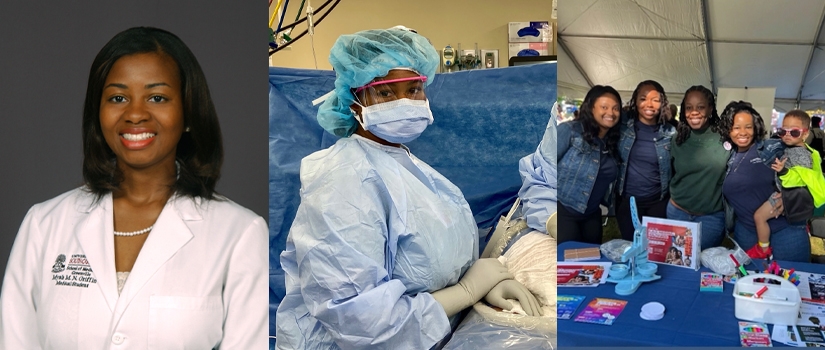
Myah Griffin, MD, FACOG, wore a hard hat to her medical school admissions interview.
In 2011, the USC School of Medicine Greenville (SOMG) was still under construction. Despite the school’s “bare bones,” said Griffin, the founding faculty and staff sold her on “the vision and dream” of what the school would be: “an institution that cares about the community.” In 2012, Griffin matriculated into SOMG’s charter class.
A Columbia, S.C. native, Griffin prioritized proximity to family and academic excellence in college. Griffin’s mother encouraged her to “reach for the stars” and proudly supported her dream to become the family’s first physician. Griffin earned her bachelor’s in biology from USC while working part-time in an OB-GYN’s office. She didn’t know it then, but that college job foreshadowed her career in maternal fetal medicine (MFM).
“MFM is a subspecialty of OB-GYN where we focus on and take care of pregnant birthing people who have high-risk pregnancy conditions,” Griffin explained. “This is a field with critical needs, particularly given the maternal health crisis in the United States and the national OB-GYN shortage.”
An OB-GYN rotation in January of Griffin’s M3 year opened her eyes to the desperate need for MFM specialists, especially those dedicated to rebuilding trust with communities whose lived experiences, shaped by historical and ongoing harms, have given rise to medical mistrust.
“As we were learning the different topics on that rotation, everything seemed to indicate that black women were more at risk for adverse outcomes: more at risk of dying from cervical and endometrial cancer; more at risk for developing preeclampsia; more at risk for having a preterm birth,” said Griffin. “As I was trying to make my decision about my specialty, I thought about how I wanted to be part of a field where I could make a meaningful impact. MFM was the area that I could do that.”
The Southeast has “some of the worst outcomes in maternal and child health in the United States,” explained Griffin. After completing her residency in Charlotte, N.C. and fellowship training in New York, N.Y., family ties and regional need drew Griffin to Morehouse School of Medicine in Atlanta, Georgia. There, Griffin is a board-certified MFM physician serving as an assistant professor in the department of OB-GYN, medical director for the Center for Maternal Health Equity, and program director for the Georgia Clinical and Translational Science Alliance - Integrating Special Populations.
Today, Griffin strives to improve perinatal outcomes and reduce adverse pregnancy and postpartum events by identifying and addressing barriers to healthcare faced by underserved and underinsured populations.
Reflecting on her commitment to compassionate care, Griffin recalled when SOMG anatomy lab professor Shanna Williams, Ph.D., taught her to “treat each cadaver with respect” and “honor the people that paved the way for the work we do.” SOMG faculty members exemplifying empathy in the classroom and on rotations helped prepare Griffin to navigate medical mistrust and strengthen connections with future patients.
“When I'm caring for patients, I think about how I would want somebody to care for me or my family,” said Griffin. “Especially among black people, there’s a lot of medical mistrust there. Think about the Tuskegee experiment and people not getting the appropriate care they need and deserve. And then think about the social determinants of health, like transportation issues or housing insecurity. All that stress plays a big role in whether people seek care, especially in a timely manner. So, I think about all of that and how to rebuild that trust.”
Griffin’s dedication to her patients shows in those who return to seek her care. Some of the most meaningful medical moments for Griffin are when patients she worked with for a previous pregnancy specifically request Griffin’s services during their next pregnancy.
“That’s something that means a lot to me, knowing that I had a positive impact and positive influence on them,” shared Griffin. “I'm grateful for the education that I received in medical school. It taught me to be a physician who cares about patients, provides an individualized approach, and teaches trainees to do the same. It served as a platform for the physician that I am today.”