
Evan Jenkins
Evan Jenkins, a May 2026 Claflin University graduate and 4+1 pathway participant, is completing his master’s degree in mass communications. A dedicated scholar and visionary, he is passionate about storytelling and media.

In 2020, CIC Dean Tom Reichert (left) and Claflin Dean Isaiah McGee formally signed an agreement establishing a 4+1 pathway partnership.
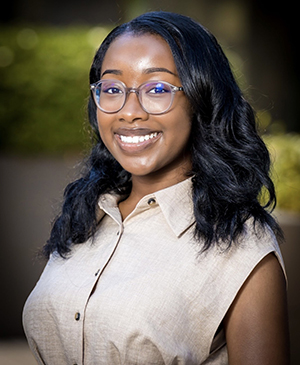
Moving quickly through school was nothing new for Kendall Brown, being that she started undergraduate classes her senior year of high school. When a professor introduced a quicker pathway to a master’s degree, she jumped at the opportunity. For her, it felt like the next step.
Brown, a Claflin University senior, is a part of the 4+1 partnership with the University of South Carolina. Eligible mass communications students begin graduate coursework as undergraduates, earning a bachelor's degree from Claflin while pursuing a master's degree from the University of South Carolina in only five years.
For Brown, the value extends beyond the speed of the program. It brings connections, independence and earlier entrances into professional spaces.
For fellow senior Jayla Odom, this path honors her mother, a former USC graduate (HRSM '99). Both are going down a pathway created by former director of the USC School of Journalism and Mass Communications Shirley Staples Carter, Ph.D., whose journey taught her opportunity matters most when students feel a sense of belonging.
Long before Carter built a bridge between Claflin and USC, she traveled a similar path. At Tuskegee University, she started her journey as she reported and later became editor of the student newspaper. After receiving her bachelor’s degree from Tuskegee University, she began her master's program at The Ohio State University as one of the few students of color in journalism.

Throughout her years at The Ohio State University, her father’s advice traveled with her: "Their best has to be your average. Let no one else define who you are.”
Carter carried her father's lesson forward becoming the second African American woman to earn a journalism doctorate from the University of Missouri. After university leadership roles, she became director of USC’s School of Journalism and Mass Communications.
As director, Carter remembered an Ohio State initiative that recruited Historically Black Colleges and University students to get graduate education. She imagined a similar pathway at USC. USC looked at Claflin as a natural partner; Claflin was the only HBCU in the region with a mass communications major. In 2020, the universities established a dual degree program agreement.
“The impetus really is to attract students to graduate programs where they can feel a sense of belonging,” Carter said. She also wanted participants in the program to reach internships, fellowships and professional opportunities beyond their campus.
That vision became real when Odera Ezenna, Ph.D, Brown’s professor and mentor, introduced her to USC faculty and staff. They stayed in contact through her junior year, making the program feel accessible.
“I was already comfortable with the idea of matriculating through school at a quicker pace,” Brown said, “I trusted it would be a good fit.”
Brown appreciates the independence graduate study provides. “I find it more rewarding because I have more control over my schedule and am surrounded by people who are also intentional about their education,” she said.
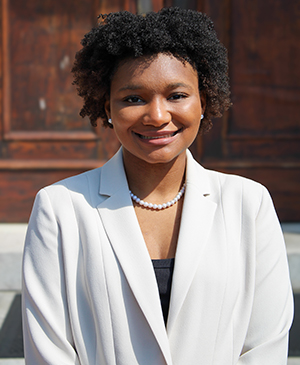
Odom’s motivation began at home. Her mother was their family’s first college graduate and later earned two master's degrees. “I always wanted to go to USC, and get my master's like my mom,” Odom said.
An Aiken native, studying mass communications and digital media, Odom photographs for Claflin Athletics and ESPN Orangeburg. USC’s coursework is more research intensive, so she created a rhythm — Mondays and Wednesdays for USC and Tuesdays and Thursdays for Claflin.
Moving between the universities has strengthened Brown and Odom’s confidence. They remain grounded at Claflin while learning beside USC professors and classmates, widening their sense of where they belong.
Carter sees that confidence as the program's main purpose. “It prepares you for the workforce,” she said. “You will be culturally proficient in the workforce because you will have had that HBCU experience as well as that Predominantly White Institution if you will.”
“What I learned is to meet students where they are,” Carter said.
That support becomes personal. Brown has gained mentors and professional contacts, while Odom is continuing a family's legacy. Their experiences show how the partnership connects ambition with opportunity and makes an advanced degree feel in close proximity.
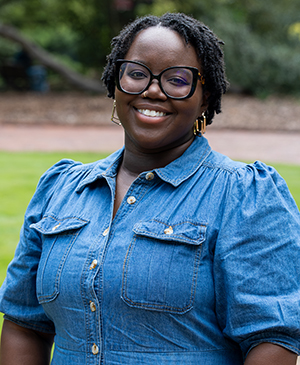
Ronni Pitts represents what can happen after crossing that stage. She entered the Claflin 4+1 program during her senior year at Claflin in fall 2021 and graduated in 2022. Funded study, a stipend and resources first grabbed her attention.
“I knew myself, and I’m not going to let a free opportunity pass me by,” Pitts said.
Claflin prepared Pitts for public relations, while USC expanded her knowledge of leadership, research and business communication. “I kind of feel confident I can fall into a good bit of anything in the industry,” she said. Her classmates and professors also became part of her professional network.
After beginning her career in news, Pitts moved into marketing and branding. She now serves as assistant director of communications for USC’s visitor center. Her master's degree, she said, strengthened her qualifications and directly helped open the door for her current role.
“The coursework wasn’t really busy work,” Pitts said. “I saw the benefit of it all, and I’ve been able to use it in my actual career.”
Pitts’ career and the progress of Brown and Odom bring Carter’s original idea full circle. What began as a plan to create access has become a living pathway between two universities and generations of students.
“If you want to say it's my baby,” Carter said, “It’s my baby.”
Evan Jenkins, a May 2026 Claflin University graduate and 4+1 pathway participant, is completing his master’s degree in mass communications. A dedicated scholar and visionary, he is passionate about storytelling and media.